
scamshield
23
A Singapore Government Agency Website
Back to home
Updated by SCAMSHIELD 127 found this helpful
Got a text saying your parcel couldn't be delivered? Here's how to tell if it's a scam
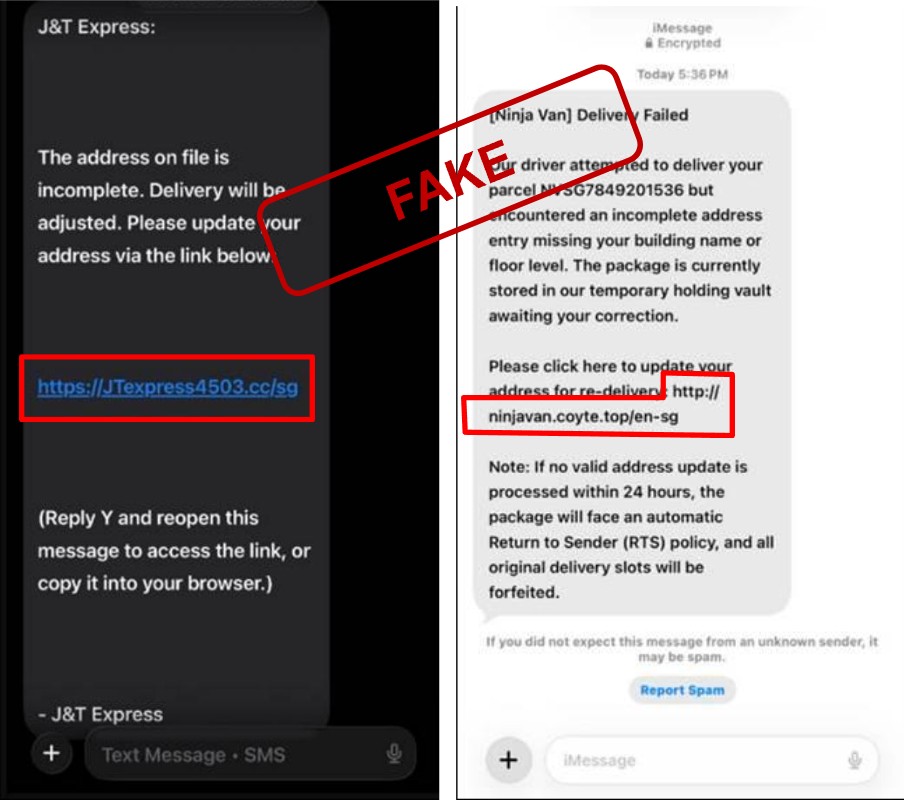
Scammers are impersonating courier companies like NinjaVan and J&T Express, sending texts and emails that claim your parcel could not be delivered due to an "invalid" address. Since 24 June 2026, the Police have recorded at least 43 cases with total losses of more than $259,000, including at least 20 reports lodged in a single day on 13 July 2026. Knowing how this scam unfolds gives you the confidence to catch it before you ever reach for your card.
How this scam works:
Step 1: You receive a text message, often from a number with the country code +212 (Morocco), or an email from a random alphanumeric address, impersonating a courier. It claims your parcel has an "invalid" address and must be updated within 24 hours.
Step 2: The message pushes you towards a link that closely resembles the courier's genuine website - sometimes only after you reply "Y" or open a separate message containing the link.
Step 3: The spoofed website asks you to pay a small "re-delivery fee", typically between $0.06 and $1.64, then enter your card details and authorise the payment using your digital token.
Step 4: Your card may then be added to Google Pay or Apple Pay without your knowledge. Most victims only find out once unauthorised transactions start appearing on their statements.
You can spot this scam the moment a "delivery update" asks you to pay through a link and authorise it with your digital token. Couriers don't collect re-delivery fees this way.
Tips to protect yourself:
Know how couriers actually operate. NinjaVan, J&T Express, and other couriers don't charge re-delivery fees through SMS or email links - genuine delivery issues are handled through their official app or hotline.
Check before you click. Type the courier's official website address yourself instead of tapping a link, or verify it via the ScamShield app.
Verify independently. If a delivery notice feels off, contact the courier directly through their app, website, or hotline rather than the number or link in the message.
Download the ScamShield app to block scam calls and filter scam SMSes. Use it to verify suspicious messages and contact details before responding.
Report what you see. If you come across a suspicious phone number, text message or website link, report it to us via the ScamShield app.
If you have already transferred money or shared your banking details, file a police report immediately at https://www.police.gov.sg/E-Services/Lodge-Police-Report.
For more information on scams, visit www.scamshield.gov.sg or call the 24/7 ScamShield Helpline at 1799.
Image (if any): Annex A – Phishing text messages
Related questions

Need more help?
Describe your issues to us.